

Beyond the Sea of Sameness
How Brand Gives Your Remarkable Property an Edge
Every remarkable property claims to be one of a kind. Most are impossible to tell apart. They chase the same ideas of “luxury” and borrow the same signals to prove it.
When guests can't tell one property from another, they default to price. That happens when an entire category converges on the same aesthetic and vocabulary.
Developers feel it as an ADR that could be higher, occupancy that's running soft, or a campaign that's not landing. Each problem is real. None is the root cause.
The real problem sits one level up. What looks like a marketing problem, a campaign problem, or a channel problem is almost always a brand problem. It’s not one developer's misstep. It's the category's. When growth rewards speed, speed rewards copying what's already proven. And when enough properties go with what's already proven, they all start looking identical.
That's the sea of sameness. Everyone makes the same “luxury”-based claims. No one stands out.
The properties that break through don't borrow the category's signals. They get specific about what sets them apart — and build their brand around those unique differentiators from the ground up.
Why the “luxury” category converged into a sea of sameness
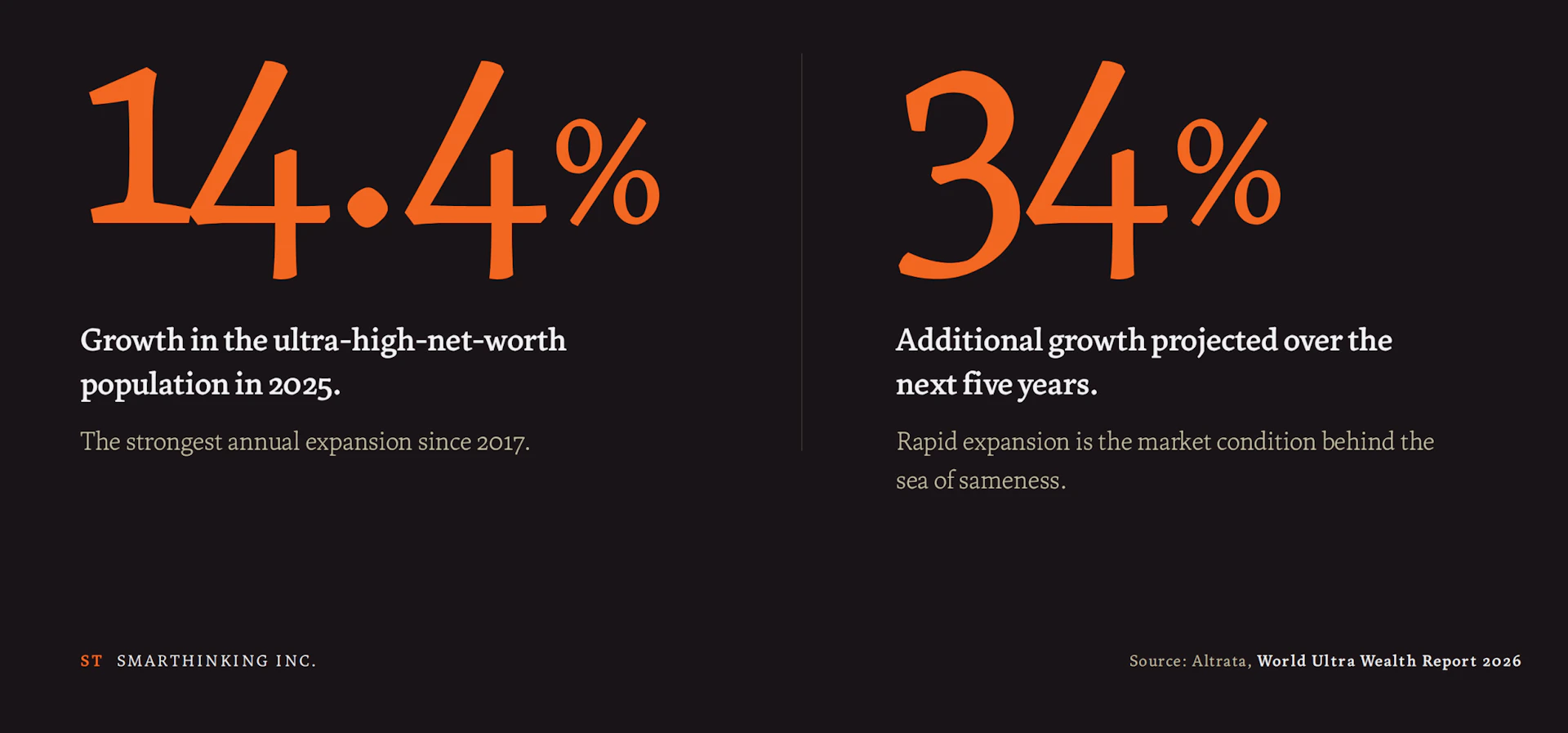
The sea of sameness is the predictable result of rapid expansion. The ultra-high-net-worth population grew by 14.4% in 2025, the strongest annual expansion since 2017, according to Altrata's World Ultra Wealth Report 2026. Researchers predict the demographic will grow by another 34% in the next five years.
Developers are moving fast to meet surging demand. When speed is the primary objective, it is safer to fall back on proven models. Someone else's approach is known and readily available. It's also, by definition, derivative, which is the antithesis of brand.
So properties develop what is easy rather than identifying what is unique and noteworthy. Look at how many high-end properties describe themselves as "legendary," "iconic," or "redefining" the category. The only thing being redefined are the words themselves, into meaningless expressions that overmarket the property and, ultimately, underwhelm the guest.
Then there's "luxury." Luxury is subjective. It's based on personal preferences and lived experiences. What you find luxurious is different from what I find luxurious. But the industry treats luxury as an immutable concept, a fixed attribute you either have or you don't. The premise is so rarely challenged that "luxury" now appears in the first paragraph of nearly every property listing in the category. What does luxury even mean when every property in the category is claiming it?
Luxury cannot be claimed. It has to be shown. The brand’s job is to do just that.
How to find your remarkable property’s “why”
Every property needs to answer the following three questions:
- Who are you?
- What do you do?
- Why does it matter?
The first two are easy — most developers get through them without much effort. The third is where the category goes quiet. It's the question that actually determines whether a property stands out as remarkable or blends into the sea of sameness.
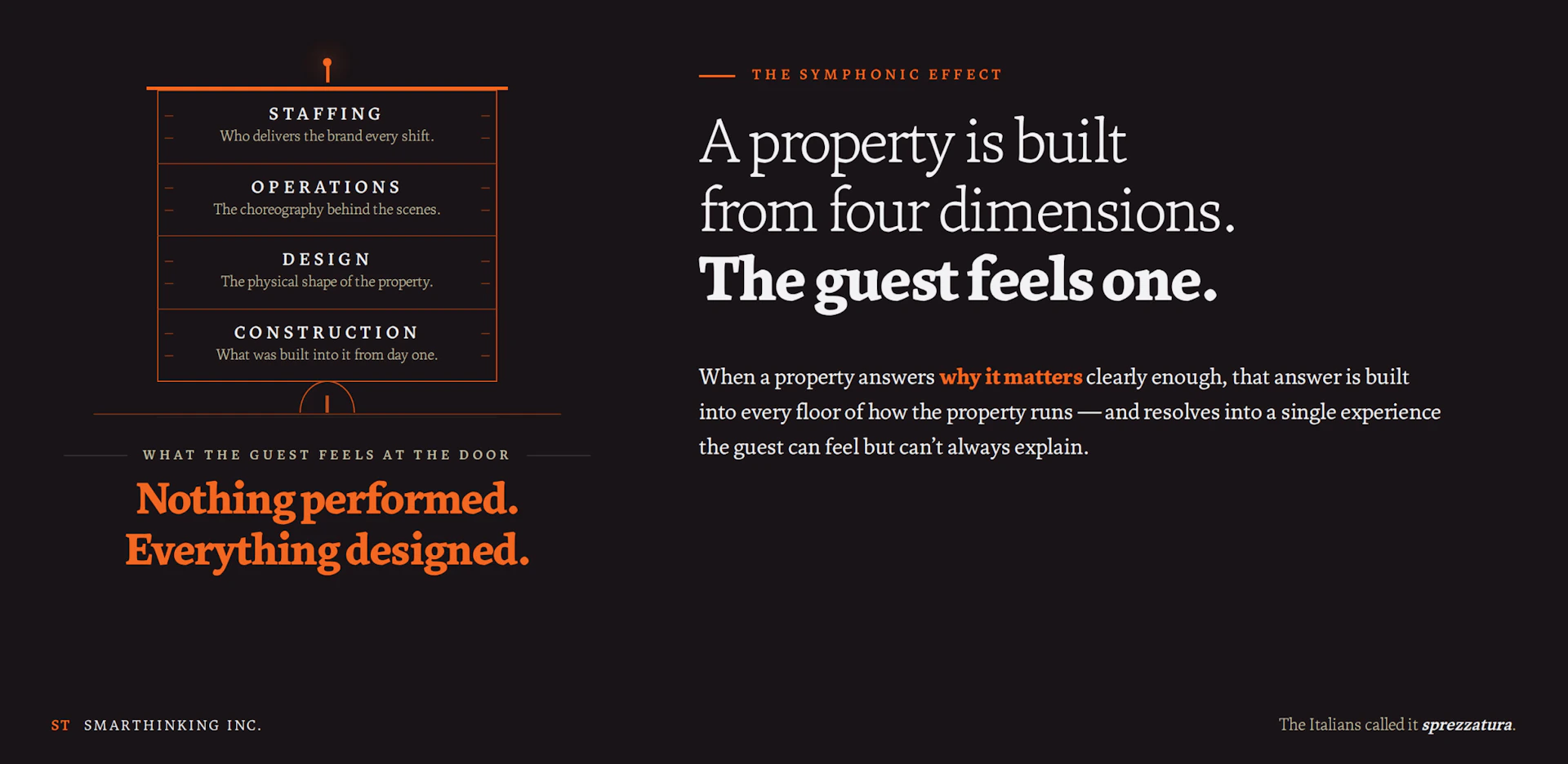
The "why" answer is different for every property. Sometimes it's the specific location and history only that property can claim. Sometimes it's the purpose the property is genuinely built to serve, carried through operations and design. Sometimes it's the point of view the owner brings, shaping decisions from architecture to hiring. Most properties draw on more than one of these elements. Wherever it comes from, your “why” has to be built into the brand itself and protected through design, construction, staffing, and operations. It can't be pulled off a shelf.
Almost every project has something genuinely interesting at its core. Too often, that standout feature or quality gets sanded down in the marketing process and replaced with category-standard language. By launch, what was remarkable has become interchangeable
The symphonic brand effect
If you go to hear the philharmonic and only the winds or the brass sections play, it doesn’t feel as emotive as when the entire orchestra plays together. A fully realized brand with a clearly defined “why” creates a deep, rich guest experience with the same symphonic effect.
The front desk interaction that perfectly sets up the first moment in the room. The signature drink and the coaster designed as a pair. When those details play together, the guest feels it, even if they can't tell you why.
I saw it recently at The Beverly Hills Hotel. The valet stand was bustling with both sleek people and cars. Everyone had somewhere to be, and now. The team moved in synchrony under the watchful, silent eye of a captain who was giving subtle gestures and signs like a pitcher on the mound. At the same time, he masterfully interacted with the guests to ensure their experience—even in that brief moment—exceeded expectations. Everything was capped off with a heartfelt thank-you and a branded receipt. Nothing was performed. Everything was designed.
The valet captain was clearly talented and hard-working. But the experience his team delivered reflected the property's brand in fully operationalized action. They had answered the "why does it matter" question clearly enough that every person delivering the experience owned it.
The Italians had a word for this in the 1500s: sprezzatura. Sprezzatura describes a certain nonchalance that conceals exertion, making whatever someone does or says appear effortless. That's what a fully answered brand looks like, from the valet stand all the way through to the last touchpoint at checkout.
Your staff needs sprezzatura to deliver your brand correctly. They can only have that if the brand story has been developed clearly enough that every one of them can embody it without a script.
The choice most properties don't know they're making
Most properties don't choose the sea of sameness on purpose. They default into it. But the properties that earn premium pricing avoid falling back on category clichés. They identify a true differentiator and build the whole brand and experience around it.
Consider two properties in the same market, built to nearly identical specs at nearly identical cost. One fetches a premium because guests can point to something about it that the other doesn't have — an authentic story rooted in something remarkable, delivered consistently from start to finish. That price gap reflects the irrational value that accrues to the best brands. It's the market pricing in a story that the competition can't match.
Having true differentiation that supports irrational value is the difference between getting it right and getting it done. Most projects get it done. Getting it done is what lands you in the sea of sameness. Getting it right is what earns the premium your property was designed to command in the first place.